33 transformation bodies of guan shi yin pu sa


1. Willow leaf guan yin 杨柳观音

"This refers to the flexibility of the bodhisattva to adept to the mind of sentient beings, liken to willow leaves swaying in the wind."

Otherwise known as bhaisajya-raja avalokitesvara 药王观音, who holds a vial of elixir in the left hand and a stalk of willow leaves in the right.

The elixir can cure all their physical and spiritual illnesses.

Devotees suffering from illnesses therefore pray especially to this manifestation, so this is also another popular form in China and South East Asia.


2. Dragon head guan yin 龙头观音

"If there are those that can be liberated by a naga or yaksa, the bodhisattva will appear in these forms to teach them the dharma."

Who appears as 天龙夜叉身 a naga or yaksa.

This form is sitting or standing on the back of a dragon flying through the clouds.

They are all celestial or supernatural beings.

But as the dragon is the highest of all beasts, it can be compared to the might of guan yin's powers.


3. Sutra holding guan yin 持经观音

"If there are those that can be liberated by a sravaka, the bodhisattva will appear in this form to teach them the dharma."

Who appears as 声闻身 a sravaka.

This form is seated on a rock with a scroll in the right hand.

A sravaka is an enlightened disciple of the buddha.

As sravakas attain enlightenment through listening to the dharma, the sutra is used as a symbol of teaching.


4. Complete hallow guan yin 圆光观音

"If there are sentient beings punished by kings, about to meet their ends by execution; by the power of invoking avalokitesvara, the blade will shatter into many pieces."

Who appears inside an all encompassing hallow of light.

This form is seated on a rock with clasped palms.

The blazing flames behind this form is a symbol of such strength.


5. Wander jest guan yin 游戏观音

"If there are sentient beings pursued by evil men, and as a result fall off the admantine mountain; by the power of invoking avalokitesvara, not a single hair on them will be injured."

Who appears falling from the admantine mountain.

This form is seated on rainbow colored clouds with one hand holding her raised knee and the other supporting her body.

The rainbow clouds are used as a symbol of such freedom of flight.


6. White robe guan yin 白衣观音

"If there are those that can be liberated by a bhikku or bhikkuni, the bodhisattva will appear in these forms to teach them the dharma."

Who appears as 比丘比丘尼身 a bhikku or bhikkuni.

This form is seated in meditation on a rock wearing a white robe.

It is the same as pandaravasini avalokitesvara of the garbhadhatu mandala.

A bhikku/bhikkuni is an ordained disciple of the buddha.

White symbolises the pure undefiled heart of enlightenment - the bodhicitta.

Incidentally this guan yin is also called the "mother-form", as almost all chinese depictions of guan yin are modeled in this image.


7. Lotus seated guan yin 莲卧观音

"If there are those that can be liberated by a prince, the bodhisattva will appear in this form to teach them the dharma."

Who appears as 小王身 a prince.

This form wears a crown and is seated in a lotus pond with clasped palms.

The exalted lotus seat represents his or her natural nobility.


8. Gush seeing guan yin 泷见观音

"If there are sentient beings to be harmed, by being pushed into a pit of fire; by the power of invoking avalokitesvara, the burning pit will become a pond."

Who appears as transforming a burning pit into a pond.

This form is seated on a cliff gazing at a distant waterfall.

Thus it is also known as waterfall observing guan yin 观瀑观音

The gushing waters are used as a symbol of such salvation.


9. Joy giving guan yin 施乐观音

"Sentient beings are in great trouble and distress, subjected to endless cycles of suffering; but through avalokitesvara's wonderful wisdom, all worldly suffering can be saved."

Who appears like the sun in the sky.

This form sits beside a pond gazing at nearby lotuses, with one hand placed on her knee and the other on her cheek, as if in deep contemplation.

She constantly contemplates on how to relieve the suffering of sentient beings using her limitless wisdom, thus giving them true joy.


10. Fish basket guan yin 鱼篮观音

 "If sentient beings meet with evil raksas, poisonous nagas and other demons; by the power of invoking avalokitesvara, immediately none will dare to harm them."

Who appears to save those running into evil 罗刹 raksas.

This form is standing on a great koi fish with crossed hands, sometimes holding a fish basket.

The great koi fish is a symbol of majesty that awes the raksas, nagas and demons into submission, and the basket is where they will be contained.


11. Virtuous king guan yin 德王观音

"If there are those that can be liberated by mahabrahma, the bodhisattva will appear in this form to teach them the dharma."

Who appears as 梵王身 mahabrahma.

This form sits in the lotus posture on a rock, holding a branch of willow leaves in the right hand and the left hand rests below his navel.

Mahabrahma is the primal sentient being and the creator deity of the hindu faith.

After the buddha appeared he has since become a guardian deity. He is lord of the realm of form, thus extremely exalted in virtue.

This is comparable to the virtue of guan yin, so this form is named virtuous king.


12. Water moon guan yin 水月观音

 "If there are those that can be liberated by a pratyeka buddha, the bodhisattva will appear in this form to teach them the dharma."

Who appears as 辟支佛身 a pratyeka buddha.

This form is standing on a lotus petal floating on water with clapsed palms, gazing at the moon.

It is the same as udakasri avalokitesvara of the garbhakosa mandala.

A pratyeka buddha is a silent saint who is enlightened from realizing the 12 causal links of existence.

This pratyeka buddha form is shown to be able to realize the the truth of dependent origination by gazing at the moon observing its reflection in the water.


13. Single petal guan yin 一叶观音

"If there are sentient beings washed away by great waters, drifting helplessly in the flood; by the power of invoking avalokitesvara, they will be able to reach shallow areas."

Who appears as 宰官身 a minister.

This form sits on a lotus petal floating on the water with one hand placed on his raised knee and the other supporting his body.

This form of guan yin is venerated for his ability to drift anywhere to help victims of water disasters.


14. Blue neck guan yin 青颈观音

"If there are those that can be liberated by a buddha, the bodhisattva will appear in this form to teach them the dharma."

Who appears as 佛身 a buddha.

This form is sitting on a rock with one hand placed on his raised knee and the other resting on another rock nearby.

A vial with a willow branch is placed beside him.

This form is the same as nilakantha avalokitesvara in vajrayana buddhism.

This form is venerated for its ability to cure diseases, alleviate sins and lengthen lifespans by swallowing the defilements of sentient beings into his throat, turning it dark.

That is why guan yin is sometimes called he with the blue neck.


15. Majestic virtue guan yin 威德观音

"If there are those that can be liberated by a celestial general, the bodhisattva will appear in this form to teach them the dharma."

Who appears as 天大将军身 a celestial general.

This form is sitting on a rock gazing at the water with one hand placed on the ground and the other holding a stalk of lotus.

This form is venerated for its ability to command awe and respect among all sentient beings with his majestic powers.


16. Life lengthening guan yin 延命观音

"If there are sentient beings plagued by curses and poisons, intending to cause bodily harm; by the power of invoking avalokitesvara, they will be returned to the original senders."

Who appears protected from harm by curses and poisons.

This form rests behind a rock with one hand placed on his cheek in contemplation and the other placed on the rock.

She wears a precious crown with buddha amitabha manifested above, and her body is a deep yellow color.

This form of guan yin is venerated for she is able to protect sentient beings from harm by all curses and poisons, thus lengthening their lifespan.


17. All treasures guan yin 众宝观音

"If there are those that can be liberated by an elder, the bodhisattva will appear in this form to teach them the dharma."

Who appears as 长者身 an elder.

This form is sitting on a coastal rock in contemplation with one hand placed on the ground and the other holding his raised left knee.

This form is venerated for its ability to protect sentient beings seeking treasures from harm if they ever meet with raksas in unknown lands.


18. Rock enclave guan yin 岩户观音

"If there are snakes and scorpians, breathing out venom like smoky fire; by the power of invoking avalokitesvara, they will all go away seeking this sound."

Who appears protected from snakes and scorpians.

This form sits meditating inside a rocky cave, gazing at the water.

This form of guan yin is venerated for she is able to protect sentient beings from harm by all snakes, scorpians and their venom.


19. Tranquility able guan yin 能静观音

"If there are measureless sentient beings going through from all kinds of suffering, who upon hearing the name of bodhisattva avalokitesvara, sincerely call on him; the bodhisattva will immediately answer their prayer and relieve them of all suffering."

Who appears in deep contemplation.

This form is leaning on a rock with both hands folded in front.

This form is venerated for its ability to give peace to sentient beings who become victims of disasters.


20. Anuda guan yin 阿耨观音

"If there are sentient beings castaway at sea, at the mercy of water dragons, fish and demons; by the power of invoking avalokitesvara, waves will not be able to drown them."

Who appears protected from hostile denizens of the sea.

This form is sits on a rock with both hands placed on the raised left knee, gazing at a waterfall.

This form is venerated for its ability to protect sentient beings who become shipwreck victims lost at sea.


21. Amate guan yin 阿麽提观音

"If there are those that can be liberated by vaisramana, the bodhisattva will appear in this form to teach them the dharma."

Who appears as 毗沙门身 celestial king vaisramana.

This form is the same as the 4 armed amate avalokitesvara of the garbhakosa.

He is sitting on a rock with both hands placed on the raised left knee, gazing out at sea.

This form is venerated for its ability to bestow fearlessness towards all sentient beings.


22. Leaf cloaked guan yin 叶衣观音

"If there are those that can be liberated by sakra, the bodhisattva will appear in this form to teach them the dharma."

Who appears as 帝释天身 sakra, king of the tavatimsa heaven, which is on the peak of mount sumeru.

This form is the same as parnashabari avalokitesvara of the garbhakosa.

He is sitting in the lotus posture on a rock with both hands folded in front.

This form is venerated for its ability to protect sentient beings from various diseases, lengthening life and also to protect households.


23. Colored glaze guan yin 琉璃观音

"If there are those that can be liberated by isvaradeva, the bodhisattva will appear in this form to teach them the dharma."

Who appears as 自在天身 isvaradeva.

Isvaradeva is lord of the paranirmita-vashavartin heaven, the highest heaven in the realm of desire where he is considered the supreme deity.

This form is the same as gandharaja avalokitesvara of the garbhakosa. Also known as 高王观音 high king guan yin.

He is standing on a lotus petal floating on the water. In his hands is a incense burner made of colored glaze.

This form is venerated for its ability to protect sentient beings from many types of untimely death.


24. Tara guan yin 多罗观音

"If there are sentient beings surrounded by hostile bandits, each wielding a sword ready to slay; by the power of invoking avalokitesvara, they will immediately turn merciful."

Who appears protected from hostile bandits.

This form is the same as bodhisattva tara of the garbhakosa.

As we know tara means 'eye' or 'deliverer'.

He is standing on a cloud floating in the sky.

This form is venerated for its ability to protect sentient beings from being harmed by vicious bandits.


25. Clam guan yin 蛤蜊观音

"If there are those that can be liberated by a bodhisattva, the bodhisattva will appear as himself to teach them the dharma."

Who appears who appears as a 菩萨身 bodhisattva.

This form seats in meditation behind a giant clam.

This form originated from the legends among China's coastal fishermen, and is venerated by them for its ability to protect them on their fishing trips out to sea.


26. Six period guan yin 六时观音

"If there are those that can be liberated by a upasaka, the bodhisattva will appear in this form to teach them the dharma."

Who appears as a 居士身 upasaka (layman).

This form stands on a rock holding a sutra text in his right hand.

This form is so called because it constantly radiates compassion towards all sentient beings, throughout the six 2-hourly periods of both day and night.


27. Universal compassion guan yin 普悲观音

"If there are those that can be liberated by mahesvara, the bodhisattva will appear in this form to teach them the dharma."

Who appears as 大自在天身 mahesvara.

Mahesvara is originally shiva of the hindu faith, but after being converted by the buddha he has since become a guardian deity.

He is also thought to be the highest deity in the realm of form, thus very exalted in power and virtue.

This form stands on a mountain top with both hands crossed and concealed in his robes.

This form is so called because its universal and equal compassion is able to benefit all sentient beings, just as the power and virtue of mahevsara is known by all.


28. Lady ma guan yin 马郎妇观音

"If there are those that can be liberated by a lady, the bodhisattva will appear in this form to teach them the dharma."

Who appears as a 妇女身 lady.

This form stands with both hands crossed in front, and is garbed in a celestial dress.

During the reign of emperor xianzong of the tang dynasty, in the year 817 AD this form appeared in the 陕右 shanyou district to convert the populace there.

The people of shanyou is fond of hunting and archery, and have never heard of the dharma.

Thus the bodhisattva appeared as a beautiful lady and enticed the men to ask for her hand, but on the condition that they can memorize 3 mahayana sutra texts.

So after 3 rounds of competition only a young man of the ma family could memorize all the texts.

So she married this young man, only to die the next day.

A few days after she was buried an old monk appeared, asking that the grave be lifted.

In it they found that only a golden collar bone remained.

The old monk then revealed to them that this lady is actually a manifestation of guan yin, who took pity on the people here and thus came to teach them.

As he finished his words the old monk simply vanished.

From then on the populace of shanyou mostly became devout buddhists.


29. Clasped palms guan yin 合掌观音

"If there are those that can be liberated by a brahmin, the bodhisattva will appear in this form to teach them the dharma."

Who appears as a 婆罗门身 brahmin.

Brahmins are people of the priest caste, thus having the highest standing in indian society.

This form stands on a lotus with both palms clasped in salute.

Although this form is of noble caste, but it is free from egoistic pride, humbly saluting all sentient beings as future buddhas.


30. Oneness guan yin 一如观音

"If there thunderous clouds spitting bolts of lightning, dropping hailstones and showering great rain; by the power of invoking avalokitesvara, they will all disperse in due time."

Who appears in control of storms.

This form sits on a lotus seat on top of a floating storm cloud, with both hands placed on her raised left knee.

This form is venerated for its ability to protect sentient beings from disastrous storms.


31. Non-dual guan yin 不二观音

"If there are those that can be liberated by a vajra holder, the bodhisattva will appear in this form to teach them the dharma."

Who appears as a 执金刚身 vajra holder (guardian deity).

This form stands on a lotus leaf floating on the water, with both hands lowered and crossed in front.

This form is venerated for its ability to protect all buddhas from unwholesome forces.

Non-dual refers to the nature of the bodhisattva's fierce and peaceful manifestations.


32. Lotus holding guan yin 持莲观音

"If there are those that can be liberated by a boy or girl child, the bodhisattva will appear in this form to teach them the dharma."

Who appears as a 童男童女身 boy/girl child.

This form, who wears a crown, is the same as bodhisattva padmapani of the garbhakosa.

It stands on a floating lotus leaf, with both hands holding a long stalk of 2 lotuses, one bloomed and the other half-bloomed.

It symbolizes the fully enlightened mind together with the mind journeying towards enlightenment.

As we may know, this lotus is a symbol of the bodhisattva's fundamental vow.


33. Water sprinkling guan yin 洒水观音

"If there are sentient beings washed away by great waters, drifting helplessly in the flood; by the power of invoking avalokitesvara, they will be able to reach shallow areas."

Who appears controlling the flood waters.

It stands on a rock holding a bowl in the left hand and sprinkling water from it with a willow stalk in the right hand.

This is exactly the same as single petal guan yin. Likewise, this form is venerated for its ability to save victims of water disasters.
Share:

Story of ksitigarbha bodhisattva


1. Story of ksitigarbha bodhisattva - story of two kings
2. Story of ksitigarbha bodhisattva - rescue his mother (part 1)
3. Story of ksitigarbha bodhisattva - rescue his mother (part 2)
4. Story of ksitigarbha bodhisattva - benefits for deceased and existing beings (part 1)
5. Story of ksitigarbha bodhisattva - benefits for deceased and existing beings (part 2)
6. Story of ksitigarbha bodhisattva - benefits from seeing and hearing him (part 1)
7. Story of ksitigarbha bodhisattva - benefits from seeing and hearing him (part 2)

Share:

Story of avalokitesvara bodhisattva


1. Story of avalokitesvara bodhisattva - prince buxuan
2. Story of avalokitesvara bodhisattva - virgin vow
3. Story of avalokitesvara bodhisattva - save victims from fire
4. Story of avalokitesvara bodhisattva - save victims from windstorm
5. Story of avalokitesvara bodhisattva - save victims from evil spirits
6. Story of avalokitesvara bodhisattva - save victims from shackles
7. Story of avalokitesvara bodhisattva - save victims from flood (click here)
8. Story of avalokitesvara bodhisattva - save sentient beings in all kinds of avatars

Share:

Huang Tingjian - 24 paragons of filial piety


Huang Tingjian was a well-known calligrapher, poet, and filial son who lived during the Song Dynasty. His pseudonym was Huang Shangu. As a man of letters, his fame was well-established during his lifetime. No matter the style of poetry, essays, or calligraphy, his work met with popular acclaim. Su Dongpo was his colleague, and the two men were known as "The Poets Su and Huang."

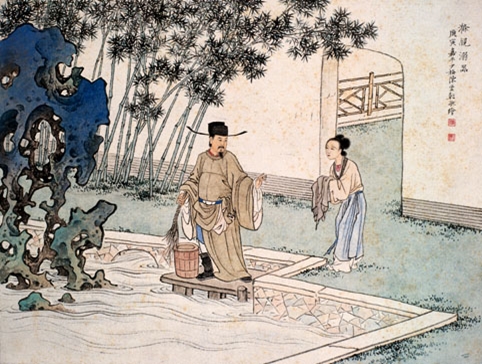
During the Yuanyou reign Period of the Song Zhezong Emperor, Huang Tingjian served China as "Chief Historian." His duty was to chronicle the astronomical events of the Period, and to regulate the calendars of the Empire. Despite his high status, he was not arrogant, or haughty. His nature, on the contrary, was respectful and compliant, especially in his filial regard for his mother. Although he had a houseful of servants, when it came to serving his mother, regardless of the chore, he insisted on performing it himself. He never required a servant or family staff person to wait on his mother. Every night he personally scrubbed out the chamber-pot his mother had used during the previous day.

His reason for seeing to this business himself was that since parents raise children to adulthood, sparing no efforts in accomplishing this difficult and often troublesome task, the children in turn, by rights should personally see to the care of their parents. They should not pass the job on to others.

A verse in his honor says:

His noble virtue; known both far and near
His life-long joy: service to his kin
He never asked the hired staff to share
The jobs that rightly, filial sons should bear

Share:

Meng Zong - 24 paragons of filial piety


Meng Zong lived during the Three Kingdoms Period of China's period. His father died when he was young, and he and his mother struggled to survive. One winter his mother was stricken with a serious illness, and craved some bamboo-shoot broth as medicine. But in the depths of winter, with snow and ice blanketing the ground, where was anyone to find fresh bamboo shoots, shoots that emerge only in the warm months? Nonetheless, Meng Zong, to avoid disappointing his mother, bravely fetched his shovel and went out into the white landscape in search of bamboo shoots. In the thicket he found only frosted leaves and green stalks coated with snowflakes and ice. Look as he might, there were simply no fresh shoots growing in the winter. The thought of his poor mother lying sick on her bed, waiting for bamboo-broth medicine, made his heartache. Uncontrollably, tears began to fall in rivers to the ground beneath the tall, emerald canes. Even now, as his tears flowed down, he kept a light of faith in his heart. If he was truly sincere in his search, perhaps ...

Just then Meng Zong nearly tripped and fell over a sharply protruding lump of earth. He quickly knelt down and knocked aside the dirt with his trembling fingers. How uncanny! Underneath his frozen hands he discovered a bed of fresh, tender bamboo shoots! Overjoyed, he gathered up a coatful and carried them back home. The broth that he quickly set stewing in the pot soon cured his mother's illness.

The neighbors, hearing the story, exclaimed that it was the strength of his sincere, unselfish, filial resolve that inspired heaven and earth to respond, and to bring up, out of season, the fresh shoots that cured his mother's disease. Before Meng Zong's prayers generated this miracle, it was normally considered impossible for bamboo shoots to grow in the winter. After the nmiracle took place, however, people were able to gather and to eat bamboo shoots all year round. The winter variety that existed hereafter became known as "winter shoots."

The villagers were deeply influenced by Meng Zong's courage and devotion. They renamed the spot where the event took place, "Meng Zong's Bamboo Grove". We can now enjoy bamboo sprouts during the winter as well, and as we do so, it is fitting to recollect Meng Zong's outstanding example of filial respect, and reflect on our conduct as sons and daughter of our parents.

A verse in his honor says:

His teardrops transformed winter at the roots
Up from the ice crept tender bamboo shoots
Instantly, the winter-sprouts matured
Heaven's will: a happy, peaceful world

Share:

Ding Lan - 24 paragons of filial piety


During the Han Dynasty a young man named Ding Lan lost both his parents at an early age, before he knew how to serve them properly. After growing to adulthood, he longed to pay proper filial regard to mother and father, but as they had left the world, he could not get his wish. He hit upon a plan that would allow him to fulfill his filial duties: he gave a large piece of fine-quality wood to a craftsman and asked him to carve it into the images of his parents. The artisan fashioned two statues that satisfactorily captured the likeness of Ting's mother and father.

When the images were done, Ding Lan reverently placed them in the living-room altar. Every day, morning and evening without fail, he would offer up incense, bow, and ask after the well-being of the statues. After he married, Ding Lan would lead his wife before the altar twice each day and perform the same ceremony of offerings to his departed elders.

His wife grew weary of the tedious ritual, and one day, out of boredom, when Ding Lan was not home, pricked the hand of one of the small wooden carvings, just to play a joke. Who could have guessed that the statue's hand would bleed! The sight of real blood dripping from the image on the altar frightened his wife out of her wits.

Ding Lan returned home and bowed before the images as usual, and noticed the eyes of one of the statues were filled with tears. Marveling at this state, he looked closer and saw a trickle of blood running down the tiny hand. He demanded an explanation from his wife. She shamefully admitted her little joke, and how she had pricked the statue's hand with a needle. Ding Lan blew up in anger, and calling his wife an unfilial wretch, he threw her out of the house and, got a divorce!

A verse in his honor says:

Wooden statues of his parents
Carved to look as if alive
Pay heed, all good sons and daughters
Serve your parents while you can!

Share:

Wang Pu - 24 paragons of filial piety


Wang Pu (Wang Weiyuan) was a filial son who lived during the Three Kingdoms Period. His mother dreaded the sound of thunder-claps. Every time the sky filled with dark clouds and rain was on the way, Wang Pu would run to his mother's side to comfort her and to calm her fears. If her son was not at her side, the old woman felt unbearable alarm.

After his mother passed on, Wang Pu buried her in a neighboring graveyard. Even though the old lady was no longer alive, every time a storm approached, and it appeared that lightning was coming, he would run to the graveside and kneel by his mother's tombstone with tears running down his cheeks. "Don't cry Mother, your son is nearby!", he would call, just as if his mother was alive. As long as the storm lasted, the man remained near the grave, circling around it countless times, to protect his mother's spirits and keep her from fear.

Later when he taught school, every time he read a passage that mentioned the emotion felt by devoted sons and daughters for their departed parents, Wang Pu's own feelings would overflow, and he would cry with deep longing. Seeing this behavior, his students would carefully remove any texts that talked about the tender feelings of children for their parents. Wang Pu always emphasized in his lessons the necessity of repaying the kindness of one's parents while they are still alive. He was considered a model of filial behavior, and his constant regard for his departed mother moved the hearts of all those who witnessed it.

A verse in his honor says:

His mother dreaded most the sound of thunder-claps
He knelt beside the bed to calm her fears
Still he hurries to her grave and circles 'round
Each time a rumbling thunder-storm appears

Share:

Jiang Shi - 24 paragons of filial piety


Jiang Shi was a filial son who lived during China's Han Dynasty. He and his wife were both devoted to serving his aged mother. The elder woman had a curious habit in that she didn't like to drink well-water. She preferred river-water, because the rapid current of the river produced cleaner water, and the flavor was much improved over well-water.

The nearest river was over six miles from the family home. Jiang Shi's wife volunteered to travel the distance every day with bucket in hand to carry back fresh river-water for her mother-in law. No one ever heard her complain of the trouble involved; she was glad to serve the mother of her husband.

Jiang Shi's mother also enjoyed eating fresh fish. On order to comply with her wishes, the husband and wife would bring back fresh fish from the river as well, and then prepare it the way she liked it. Further, they would invite in all the elderly women from the neighborhood to enjoy the meal, so that their mother would have company with her dinner.

The two filial children passed many years in this way, and they never expressed dislike or resentment over the toil. One day a spring gushed up right behind the house, and its flavor was just like that of running river-water. Strange as it may seem, two carp would leap out of the spring each day, as if waiting for Jiang Shi's wife to gather them in for the meal. Ever after, the couple did not have to travel so far to serve their mother, and without as much tiring effort, they could still bring her river-water and fresh fish.

A verse in his honor says:

The son delights in his filial regard
The daughter, too, finds service not too hard
Every morning carp came leaping out
Of the sweet-dew spring in their back yard

Share:

Huang Xiang - 24 paragons of filial piety


During the Han Dynasty, a nine-year-old boy named Huang Xiang became famous as a model of filial service to his father. His mother had just died, and the young boy noticed that his father was wasting away with grief and loneliness. He resolved to make it his business to cheer up his father. After making that decision, there was no job in the house too troublesome for him, and he performed his chores with vigorous, positive energy. His only concern was to spare his father worry and anxiety. While the elder Hwang read by the light of a candle, Huang Xiang, in the sticky heat of the summer's evening would fan the pillows, so that they would be cool when his father went to sleep.

In winter, when the freezing winds and drifting snow turned the world to ice, the little boy would first hop into his father's bed to warm up the blankets. Then he would call his father in to come sleep in the cozy nest he had made. Mr. Huang was deeply touched by his son's considerate treatment, and his mind was greatly calmed. To have such a rare person as his son, who spared no details in serving as a dutiful child, was certainly a blessing. The story of Huang Xiang's behavior spread far and wide. Eventually his reputation as an exemplary filial son reached everyone in the land. "There's no one to compare with Huang Xiang anywhere", was a verse that could be heard throughout China.

The magistrate of Jiangxia, named Liu Hu, heard of a nine-year-old filial child in his district who understood the principles of filial respect, and made a special petition to the Imperial Court for recognition of Huang Xiang. How glorious and noteworthy was Huang Xiang's filial regard!

A verse in his honor says:

In winter months he warmed the sheets just right
And fanned the pillows on hot summer nights
In knowing how to be a filial son
In all these years, Huang Xiang's still number one

Share:

Cai Shun - 24 paragons of filial piety


During the Han Dynasty, there lived a devoted son named Cai Shun, whose father passed away when the boy was quite young. He and his mother relied on each other to survive the days and years. Wang Mang had just usurped the throne at that time, and the entire country was in great commotion, suffering a famine, a drought, and a civil war in progress all at once. The people suffered from these dire calamities, many families starved, and those who could manage to do so, were forced into the fields to forage wild plants and roots for food. Often, decent men turned to banditry and robbery, just to pass this time of hardship. The roads were infested with gangs of thieves; the forests were havens for the homeless and the desperate.

One day Cai Shun took two wicker baskets out into the woods to gather mulberries for his mother. Beneath the trees he ran into two wicked looking robbers. They were carrying long sharp swords and their faces were cruel and dark."Hey kid, don't you want to live? How do you dare invade the big Boss's territory?" shouted the biggest of the bandits. Little Cai Shun was scared. The smaller bandit looked closely at the boy's work, planning to eat anything of value. "Child, why are you tossing that fruit into two baskets?" Cai Shun answered in a trembling voice: "The black mulberries are riper and sweeter. I give those to my mother. The red ones are not ripe, but sour. Those I eat myself, sir. I hope you two gentlemen will not kill me or else my mother won't have anybody to look after her."The boy's earnest simplicity and honest answer touched the two thugs' heart of compassion. Remembering their own parents' suffering, they decided not to harm Cai Shun. Instead they supplied him with food and drink, and released him back to his mother.

A verse in his honor says:

The black mulberries went to feed his mother
Whose blouse was stained with tears from hunger's pain
The red-browed thugs heard his filial thoughts
Then gave him meat and rice and set him free

Share:

Dong Yong - 24 paragons of filial piety


Dong Yong lived during the Han Dynasty. As his mother had passed away years ago, he scratched out a meager living to support his ailing father. Dong Yong found work as a farm laborer, and earned barely enough to support his father. The old man was an invalid, so Dong Yong would carry him to a cart and tenderly wheel the elder to the shade of a tall tree beside the field where he was working. In this way he was able to keep his job and also nurse his father at the same time. Several years passed, the senior Dong died. Dong Yong, having to spend all his penny on medical care, found himself unable to pay for a proper funeral. He had to sold himself into bondage as indentured servant in order to scrape funds for a coffin.

Having sent off the coffin, the young man headed for his owner's house. A pretty girl met him on the road, and told him her story, how both her parents had passed away, and how she couldn't locate her relatives in the area. She said she hoped that Dong Yong would be kind enough to take her in, so that she could have some security and reliance. He found no objection and the two of them asked Heaven and Earth to be witnesses as they pledged their troth then and there.

Together they entered the home of Dong Yong's indentured Master, an extremely miserly weaver. He read the labor contract to the couple, and demanded three hundred bolts of perfect cloth to redeem the freedom of Dong Yong. The young man was not afraid of hard work, but figured out that if man and wife co-operated and joined their strength, it would take at least three years of labor before the task could be completed. To Dong Yong's surprise, the new bride wove all three hundred bolts of cloth in less than a month! The weaving boss was even more astonished when the young couple handed over the perfect fabric and, contract in hand, gaily walked out the door to freedom.

They strolled past the tree where they had first met, and his wife suddenly fell silent. Her countenance glowed with an uncanny light, and Dong Yong asked her to explain her demeanor. "I now have my freedom, you should be happy!" Tears ran down her face as she said, "I am an Immortal. Your heart of filial respect is so noble that I was touched, and came down to this world to assist you in your task. But now I must return, I am not able to stay with you. Take good care of yourself."

Dong Yong couldn't bear to part with her, but how could he prevent an Immortal from returning ? Helplessly he watched his wife slowly ascend into the sky.

A verse in his honor says:

His father's funeral sent him into servitude
A maiden charming and immortal, met him on the way
They wove the cloth that ransomed back his freedom
His filial conduct touched even Heaven

Share:

Yu Qianlou - 24 paragons of filial piety


Qianlou lived during the Period of the Northern and Southern Dynasties, in the state of Qi. He rose to office and served as the governor of Jianling for only ten days, when for no apparent reason, as he worked in the capital, he broke out in a cold sweat, and his heart palpitated, and would not stop.

"Do you suppose there is a problem at home?" he wondered. Being devoted son, the duties at home always sat foremost on his mind. Immediately he resigned his office and hurried home. After arriving he discovered that as he had feared, his father had suddenly been stricken with a strange illness that the doctors could not diagnose. "If you want to know your father's prognosis and chances of recovering, you must test his stool. If it is sweet-tasting, then the malady is serious, and chronic. If it tastes bitter, then the problem is acute, and short-term," said the doctor. Lacking any sophisticated testing procedure, the physician advised Yu Qianlou that he would have to taste the old man's excrement to determine whether he could quickly recover from the disease. Qianlou promptly sampled the stool and to his dismay, found it sweet-tasting.

That night, in desperation, he lit a stick of incense and knelt before the family alter, and prayed to Polaris, the Pole Star. "If my father can recover his health, I will offer up my life in exchange for his. Take me and let him live," he vowed. After news of Yu Qianlou's courageous oath got around, the family and neighbors all praised him as a truly extraordinary, filial child.

A verse in his honor says:

He served in office but a few brief days
When father caught a strange and awful disease
Qianlou looked North, and bowed to star Polaris
"Take me instead," he vowed from bended knees

Share:

Zhu Shouchang - 24 paragons of filial piety


He told the whole story to the crowd, and related all that he had experienced in search of his mother.

From the midst of the throng stepped an old woman. "You are my son! I haven't seen you for fifty years!" cried the lady, her voice choked with tears of joy.

The weary traveler, having realized his heart's desire, happily embraced his mother and shortly thereafter, took her home to care for her properly.

A verse in his honor says:

He said goodbye to Mama at age seven
He served the land with skill for fifty years
One day he wished to see his long-lost mother
His journey done, they both wept joyful tears

Share:

Yang Xiang - 24 paragons of filial piety


In the time of the Jin Dynasty, a boy of fourteen years, named Yang Xiang used to follow his father to work in the fields each day. One morning as they climbed down to the paddies to harvest rice, from out of nowhere a large, striped tiger appeared before them. The tiger scooped up Yang Xiang's father in its mouth and headed back to the forest. "Save me! Save me!" cried the boy's father. Hearing his pathetic wails, Yang Xiang anxiously looked for his Father. He saw the big cat carrying the old man away. With no thought but to rescue his father from mortal danger, and completely forgetting about his own safety, the boy ran headlong after the tiger. He leap up on the tiger' s back and using every ounce of strength, he choked the animal tightly by the throat.. Throttled in a death-grip by Yang Xiang, the tiger fought for its breath. He had to drop the man he carried in his fangs. Frightened by the ferocity of the young boy's attack, the tiger put its tail between its legs and ran for its life.

Saved from death's door, Yang Xiang's father was in shock, but otherwise unhurt. Yang Xiang watched the tiger disappear into the forest, and then carried his father back home to recover. When news of the incident reached the neighbors, they heaped praise on the boy, calling him a heroic, filial child.

A verse in his honor says:

In the wilds they met the fierce white jaws
Yang Xiang punched hard, and choked the smelly beast
Delivered to safety were father and devoted son
Snatched back alive from the tiger's mouth

Share:

Guo Ju - 24 paragons of filial piety


Guo Ju lived during the Han Dynasty with his wife, his aging mother and their three-year-old son. The household was extremely poor, and the four of them often found it difficult to make ends meet. There was rarely enough food to go around. The grandmother, being fond of the baby, would often take her scanty portion of food and feed it to her grandson. She never got enough nutrition and frequently went hungry. As the baby grew, the elderly woman's health deteriorated, and before long, she fell sick.

Since Guo Ju could afford neither nutritious food nor medicine to heal his mother, his heart felt great consternation. He discussed the situation with his wife, saying, "We are unfilial children. We can't feed our mother properly, and now she is sick! What are we going to do?" His wife had no solution. Guo Ju couldn't sleep at night. His heart was agitated and upset.

In desperation, finally he resolved to part with his own son, in order to serve his first allegiance, his mother, in proper fashion, during the final days of her life. "Perhaps we can have more children in the future," he told his wife, "but mother in her old age deserves our best offerings and care. Don't you agree?"

Guo Ju's wife, although she loved her infant son, was also a devoted filial daughter. Nodding her head and weeping with grief, she agreed to go along with the heart-rending solution to their problem. The two of them carried the infant into the back yard, and with a planter's hoe, Guo Ju dug a hole in the earth. Before he had dug down three feet, he heard a loud thunk! and felt something solid beneath the hoe-blade. He dug more carefully, and unearthed a sturdy metal chest. Opening the cover, to their astonishment, they discovered a pile of golden coins and silver bars, worth a king's ransom. "Oh, look!" the husband and wife exclaimed. Written on top of the casket was a sentence: "A gift to the filial son Guo Ju."

The couple took the fortune in gold to the local magistrate, but owing to the inscription on the lid, and the unusual circumstances surrounding its appearance, the government officials returned the money to the husband and wife. Guo Ju promptly found a doctor and medicine for his mother, and was able to keep his son alive. The family ever after had sufficient supply of life's necessities and enjoyed the blessings due to filial children.

A verse in his honor says:

Guo Ju wished to serve his aging mother
He buried his son, so that she might live
The gods rewarded him with golden coins
Their brilliant gleam lit up his humble hut

Share:

Wang Xiang - 24 paragons of filial piety


During the Jin Dynasty, a young boy named Wang Xiang (Wang the Lucky) lost his mother to illness. His father took another wife so that the boy would have maternal care. His stepmother, however, was a bad-tempered, evil-natured woman, who took a dislike to her stepson, and often berated him in front of his father. This went on incessantly, and eventually, she managed to turn Lucky Wang's father against the boy. Despite this hardship, Lucky Wang remained devoted in his filial regard for them both.

One winter it was unusually cold, and snow fell for many days. The snow piled up on all sides of the house, and the small creek nearby froze solid with ice. The severe weather forced the family indoors, and all the animals found shelter wherever they could. The world outdoors was a broad blanket of white. Wang Xiang's stepmother took sick. She craved medicine, and her thoughts fixed on the image of fresh fish. She demanded fresh carp as medicine to cure her illness. As it was still snowing, and everywhere the rivers had long since frozen solid, where could fresh fish be found? Lucky Wang was a dutiful son, however, and could not bear seeing his parents unhappy.

He forced his way out into the cold and walked to the creek side to see what he could do. The snow was piled deep, and the boy shivered in the cold. He looked and looked, but found no access to running water. Tired and disappointed, he sat down on the ice and lamented his failure to find fish to cure his mother. Having no way to solve the problem, he simply let his tears flow. An idea came to him as he cried, and having no recourse, in his desperation, he removed his coat and shirt, and lay down on the ice amid his hot tears. The more he cried, the more upset he got. The more upset he got, the more his tears flowed. Before long, his body heat and the apidly expanding puddle of tears melted a hole in the ice. Two carp that had been frozen into the river-water suddenly leaped up out of the crack in the ice and flopped onto the bank. Amazed and delighted, Wang Xiang scooped them up and carried them home to his ailing mother.

Seeing the two live fish, Wang Xiang's stepmother felt thoroughly ashamed of her selfishness. Afterwards, she changed her attitude towards her stepson, and became a kind and caring person. Many people said that Wang Xiang's response came from his sincere filial devotion. His noble attitude moved Nature into giving him a reward.

A verse in his honor says:

Stepmothers abound on this earth
But rare are sons like Lucky Wang
Even now when the river freezes over
We recall his icy sacrifice for Mother

Share:

Wu Meng - 24 paragons of filial piety


In the Jin Dynasty, a filial eight-year-old boy named Wu Meng served his parents with devoted compliance. His family was extremely poor and could not afford mosquito netting.

On hot summer nights the mosquitoes would come swarming in as thick as smoke. The little boy would remove his shirt and let the insects land on his bare skin. He would watch then drink their fill of his blood, and fly away; he wouldn't raise a hand to shoo them off, no matter how painfully they stung him. Wu Meng wasn't a fool, so why didn't he brush the bugs away? He knew that his parents had no netting at their bedside. If he drove the mosquitoes away from his body, they would surely fly over and wake up his mother and father with their stinging. So the devoted son simply let the mosquitoes drink his blood instead. So that his parents wouldn't know about his sacrifice and demand that he stop, the boy would wake up earlier than they, slip his shirt over his swollen torso, and return to his own bed. But one morning, being tired from loss of sleep, he forgot to wake up and pull on his shirt. His father arose and found his son asleep by his bed. He looked at the boy' s pathetic, mosquito-bitten skin that was covered with red welts, and understood immediately what Wu Meng had done. Mr. Wu woke up his wife and told her the story. The two parents, deeply moved by their son's unselfish concern for them, began to cry. They were so touched, their sounds of sobbing could be heard by the neighbors. From all sides the neighbors gathered to investigate the matter, and learned about Wu Meng's sacrifice on behalf of his parents.

Everyone thought that the boy's attitude of filial respect was most remarkable, especially for one only eight years old. Someone reported the incident to the local magistrate, who wrote a memorandum to the Dragon Throne, to inform the imperial court. The matter thus came to the attention of the Emperor, who rewarded Wu Meng with a scholarship to the academy. Further, he gave the family a set of mosquito nets and a stipend, so that they never again lacked the necessities of life.

A verse in his honor says:

Summer nights and no mosquito netting
Insects by the thousands, yet he wouldn't raise a hand
"Let them drink my blood and fill their bellies
Just don't disturb my parents while they sleep"

Share:

Lady Tang - 24 paragons of filial piety


In the Tang Dynasty, an official named Cui Nanshan, had in his family the Grand Dame Zhang Sun, Mr. Cui's great-grandmother. She had lost all her teeth, thus she could not chew even soft rice. Eating was a big problem. Mr. Tswei's grandmother, the Lady Tang, realized the difficulty her mother-in law had in chewing food, and thus hit upon a solution to keep the Grand Dame alive and in good health. The Lady Tang would wake up each morning, perform her daily toilet of washing her face and combing her hair, then she would enter her mother-in-law's chambers and proceed to feed her breast-milk from her own body. The elderly matron had no trouble digesting this nutriment, and thus thanks to her daughter-in-law, even though she could not eat normal food, her body stayed strong and healthy.

One day she fell ill, and knowing that her life was about to reach its natural end, she summoned all her generations of descendants into her room and told them, "All these years I have been looked after by my daughter-in-law. She has treated me most kindly, and I am deeply grateful to her. I only hope that the wives of all my children and grandchildren will be as considerate and proper in their filial devotion as she has been towards me."

When the family heard her final words, they were deeply impressed, and ever after, used the Grand Dame Jang Sun's advice as the motto of the household. The teaching was passed down and cherished through the many generations of the Tswei family.

A verse in her honor says:

Out of deep respect for the Tswei Family's matron
After morning toilet she would feed the Grand Dame milk
Kindness such as this is difficult to repay
May every generation of descendants be so kind!

Share:

Lu Ji - 24 paragons of filial piety


In the Later Han Period, a young boy of only six years old showed a deep filial regard for his mother. He traveled with his father to visit the Chief Minister of Nan Yang, named Yuan Shu. Elder Yuan Shu saw how precocious the young boy was, and ordered his butler to bring a dish of oranges to offer to young Lu Ji. The boy saw the delicious, large fruit, and immediately ate two. He waited until nobody was looking, and secreted three oranges away in the sleeve of his robe. When it was time to say goodbye, along with his father,little Lu Ji raised his hands up in salute. Unexpectedly, the three oranges came rolling out, and fell to the floor in front of Lu Ji.

Yuan Shu saw the oranges and laughed: "Little Brother, you're my guest today. How come you stole your host's oranges?" The little boy replied, "Pardon me, my mother likes oranges best of all. Because we don't have any money, it's hard to provide oranges for her. Today I enjoyed two of these ripe, sweet, oranges, and I could not resist taking a few of them back for Mother. She likes them so much." Minister Yuan Shu was impressed by the six-year-old's concern for his mother's happiness. He told his staff to give the entire plate of fruit to Lu Ji for his family.

A verse in his honor says:

Filial love and brotherhood made nature "Heaven-True"
Most rare in a boy just six years old
He hid three oranges in his sleeve, as a gift for his Mom
Just a token to repay her kindness without end

Share:
Scroll To Top